Many Christians, including Catholics think that faithful assent to the Church’s doctrinal teachings is akin to an absolute surrender of reason and will. Post-modernism has bred such an emphasis on self that every man, woman and child always knows better than the collective wisdom of the Church.
Even clergy and religious sometimes hide their contempt for certain Church teachings by dressing their disobedience under the excuse of what they call “faithful dissent”.
In other words, “I disagree and disobey but I’m nevertheless a faithful Catholic because I choose to think for myself, and I think the Church is wrong on this subject so in obedience to a greater truth (usually mine), I must dissent.”
First off, there is nothing wrong with thinking for yourself. Faith and reason are not in battle with each other in the Catholic faith. Indeed, they co-exist in a perfect marriage where one complements the other. After all, God gave us the spirit to believe but he also gave us a mind to understand what we believe, and we are to use both. But in a world of shifting principles and democratic consciences, any claims to eternal or absolute truths can certainly upset anyone who has been weaned on contemporary ideas of personal choice and freedom.
For many, morality is not indisputable but adaptable. Truth is not eternal but relative, and “conscience” is just another word for exercising my right to decide for myself, rather than the imprint of the eternal God who infused our souls with that natural gift of sensing what we know by nature to be right or wrong, good or evil. Where that instinctive knowledge has been suppressed, dulled or ignored for too long, then a false sense of moral principles fed on the ideologies of the world and the appetites of the ego replaces the true conscience as the fulcrum of a person’s code of conduct and thinking.
G.K. Chesterton put it well when he said, "When people stop believing in something, they'll start believing in anything." A conscience in reality is a spiritual muscle. The more you exercise it, the stronger it becomes and the more sensitive to good and evil it is. The less you use it or worse, try to suppress it; it will eventually be reduced to a state of spiritual muscular dystrophy. How then can it support a moral life?
God has given us tremendous attributes in this life, each of which is a tool designed by the creator to serve and help us when used as intended. Naturally when we use something in a way other than it was designed for, we risk not only ineffectiveness but also a real danger to life and limb. A can-opener does a great job of slicing open our canned dinner but it is hardly an appropriate tool for trimming your nails unless you have extra fingers to spare.
Think of your conscience and reason as a car. It can get you places and bring you to your eternal destination, but only if you drive it whilst being mindful of the rules that govern the highways of life. However, if you do all kinds of modifications to your car, or worse, you let it fall apart and then choose to ignore safety signs on the road, then you put yourself and others at risk because you become a danger to everyone else driving on that highway. When that happens, your “Aston Martin” is more likely to serve as a flaming coffin that propels you to certain death rather than the reliable means for bringing you home. After all, being placed behind the wheels can be intoxicating to anyone who doesn’t temper such power with humility and faith.
What’s more, we should recognize that since Genesis, there exists a voice that has sought to offer us an alternative code of morality to the one God envisioned for His children. He didn't tell Adam & Eve to do away with a conscience, he was much too sly for that. Instead, he convinced them that they had the sole power to know for themselves what was right or wrong.
“Eat of the fruit of the tree”, he said, then you shall know the difference between good and evil and you shall be like God. With this ultimate lie, this wretched creature convinced our first parents that “God doesn't want you to eat from the tree of knowledge because He knows that you will become like Him; you will become powerful and self-sufficient and will have no need of Him. That is why He hides that power from you, so that you may never know or enjoy that ability". Sadly it was this temptation to be our own Gods, to be subservient to no one, to be answerable to no master but the high altars of our own egos that plunged the world into darkness and rebellion.
Today, Satan continues to say to us, "You don't need the Church to point out what is good and evil. You have the power to decide this for yourself! The Church wants to keep you oppressed because she knows that you won't need her when you can decide on your own. You can be your own Church, your own Pope, and your own Gospel. It is only fools and old unthinking masses that bow their heads to the Church and her high-handed hypocrisy and thus live lives of utter sadness and oppression."
Why do you suppose popular culture and Hollywood constantly depict Catholics as ignorant, superstitious, pathetic and sometimes cruel, but always as tortured souls suffering great misery? Yet anyone who lives a genuine Catholic life will tell you that it’s a life resplendent with joy and grace.
Still, it’s no secret that the world identifies Catholicism as the bastion of oppression and injustice. To be a Catholic is to be robbed of original thought and reason; to be denied the freedom to do whatever you want, to express yourself in anyway that you feel comfortable. It's the "I gotta be me" mentality described by the late Archbishop Fulton Sheen.
The Catholic idea of freedom however is not quite the same thing. It is the freedom to choose wisely, to act responsibly and to be delivered from whatever addictions and sinfulness that can chain an individual and blind him to the right choices in life. The fact is, freedom as a gift is not an end in itself, nor is it the pathway to self-gratification.
Is the man who is free to indulge in drugs, adultery, fornication, pornography, homosexuality or excessive drinking truly free, when every such opportunity saps him of his strength to say "no" and rise above his wanton desires? Of course not. Rather, true freedom liberates us to be authentic witnesses in this world to the reality of God and truth. And one cannot do this when one is imprisoned in a thousand ways through false ideals, lifestyles and choices.
Now and then we are told that to make a financial killing, we need to listen to the advice of our brokers. To get a sharper nose, we gladly acquiesce to plastic surgeons. To have more prosperity, we obediently seek out geomancers and fortune-tellers, but to live rightly and justly for our happiness, we are outraged that the Church's teaching office or Magisterium should presume to tell us how to live our lives - they who receive their commission "to feed my sheep" from Christ Himself.
Tragically some things just don't change. Maybe that’s why Satan has such a field day convincing generations of men to follow in the footsteps of their first parents.
A conscience, despite being a natural gift from God, still needs to be formed and cultivated. This is where religion comes in. A man with a badly formed conscience will not be able to rise to the occasion under attack. Besides, how can we truthfully say "each man according to his own conscience" when some have such poorly formed ones as to appear to have none?
Hence to preserve and protect us, Christ our Lord gave us more than a conscience, He gave us the Church to preserve and form that conscience in order that through the Holy Spirit, we might be delivered from the idolatry of self-worship.
Truth is immutable and unchangeable. We are not the benchmarks of morality in our own lives. Christ is - The same Christ yesterday, today and tomorrow. The same Christ who commissioned one Church in particular to speak for Him definitively.
That might explain why the Catholic Church is so reviled as an icon of moral steadfastness in societies that expound an ideology of convenience and gratification. At the same time, she is often admired for her unwavering courage by people disillusioned with the transient solutions offered by society today. Her defense of traditional teachings in the face of trends, political correctness and popular theologies, effectively sets her as a thorn in the sides of people who recognize the seeds of truth in her words, regardless of how much they might insist on drowning that out.
Remember that the Church has never taught her doctrines and moral ethics because they were popular or even practical! She teaches them and maintains that she has no right to alter them for one reason alone - She is convinced that it expresses the will and intention of Christ Jesus her Lord and King, in whom her only duty is to obey and adore. That is why Jesus warned His disciples that the world will hate them as it hated Him, it will reject them as it rejected Him, and like her Master, the Church will be "a sign of contradiction" to the world, just as the Cross continues to be a sign of contradiction to the world.
Anyone who prides himself on being more progressive, forward-thinking and obviously more "enlightened" than a 2000 year old Church without even seriously investigating its doctrinal stands with some degree of honesty does a great deal of disservice both to the Church and to himself. And it is not uncommon for many in this day and age who are hungry for truth to be seduced by new fads, theologies and spiritual appeals that more often than not, distill Christian truths in their claims to shed more light.
Unfortunately, many (including priests and religious) who are most prejudiced against orthodox Catholicism, sadly also do not allow themselves to seriously study anything from conservative or traditional Catholic sources before condemning them. Instead, armed with what little knowledge they derive from some dissident source of literature, they feel comfortable abandoning two millenniums of magisterial teaching, saints, martyrs, doctors and the infallible promise of Jesus without bothering to weigh the arguments for the Catholic position seriously.
If this was an operation on a life and every doctor jumped at a new, fancy, popular treatment without objectively weighing these claims against proven medical histories and knowledge, they'll end up killing hundreds. In spite of that, many Church leaders, pastors and theologians feel they have to constantly reinvent Catholic theology by challenging the Church's heritage with hostility that borders on the insane. Instead of claiming to speak for Catholic truth, at the very most they can only present these novel ideas as their own.
Yet it is this crazed hunger for something new, something different, something exotic that dominates so much of their theological wrangling that they lead the faithful into a chasm of mistrust and confusion about the Church's teachings, often times just for the sake of seeming revolutionary. At best, they merely succeed at reinventing the wheel. At worst, they promote heresy and confusion among the faithful.
This is not to suggest however that Catholic Theology can bear no dialogue, that to raise doubts is to risk being struck by a bolt of lightning. That is not what we are saying.
The theology of the Church is made more manifest and clear through the contributions of great Catholic minds who delve into divine mysteries in a genuine effort to understand and articulate these truths. In order to grow, there must be courage to explore, to ask questions and to try new ways of thinking, but always and everywhere, this must be done in the context of Catholic understanding and tradition as far as divine revelation is concerned.
This is the backdrop. This is where we must return in our quest for a more authentic Catholic identity, even if our thoughts explore and stretch the boundaries of divine science; because in the end, theologians cannot be said to be expounding Catholic theology if what they teach contradicts and attacks the essence and nature of the Catholic faith - just as you cannot genuinely claim to be Catholic if your life bears no resemblance to authentic sacramental living within the Catholic Church. It is the duty and function of theology to question, think and study the truths in divine revelation in order to bring out their clarity and light, not to change and alter these truths into something entirely alien, or to invent a new revelation so to speak.
Author and apologist, Scott Hahn once commented that to agree with what the Church teaches is not faith, it is coincidence. You have a set of beliefs that you subscribe to. And coincidentally, the Catholic Church has an identical set of beliefs. Faith is when you encounter a teaching that is difficult, but you recognize the spiritual authority and wisdom of the Church and you bow your head in obedience, knowing that where your human efforts end, the Holy Spirit supplements with a wisdom and love that never fails.
The truth is, agreeing with Jesus has never been the condition for accepting His teaching. For His Apostles, His words were all that was necessary. They believed because He said it was so.
In the Gospel of John, many of Jesus' disciples abandoned Him because they could not accept His teaching that they would have to eat His Body and drink His Blood. No one could fault them for appealing to logic; it just did not make sense. However, instead of explaining Himself, Our Blessed Lord turned to Peter and the eleven and asked them, "What about you, will you leave also?"
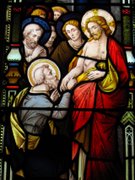
Faith succeeds where human knowledge fails. It was Peter who responded despite not understanding, "You have the words of eternal life Lord, to whom shall we go?" John 6:68
Some people may be tempted to interpret this as implying that we should blindly accept all that the Church teaches. On the contrary, there is nothing in Catholic teaching that goes against the grain of reason. God didn’t just give us a heart to love Him; He also gave us intelligence to know Him and a mind to understand His will. Faith is not incompatible with reason, and it’s a tribute to the wisdom of the Catholic Church that she recognizes both as complementing each other in the life of a believer.
Therefore, do not be discouraged when questions arise. Many times, the Apostles themselves could not understand the Lord's teachings, at least not until the Holy Spirit came upon them and opened their minds to the mysteries of His Revelations. Very often, these episodes of clarity occurred much later in their history when they had grown more mature as Christians. So the next time you come across a difficult Catholic teaching, don’t be too hasty to pronounce judgement until you’ve heard all the evidence.
Read, study, question and research! You’ll be surprised at the wealth of Catholic resources available to those who want to know their faith better. You owe it to yourself to seek and discover the truth, instead of quietly assuming that the Church is erroneous in her moral claims. The least we can do in such a dilemma is to honestly try and understand the Church's position for ourselves, instead of relying on prejudicial hearsay.
Above all, pray! Let us sincerely ask the Lord for illumination. Because like Peter, we can also say to the Catholic Church, the true Bride of Christ, our Mother, "You have the words of eternal life, to whom shall we go?"
 Dancing is not one of my fortes. Even though I sometimes take recklessly to the dance floor, I’m about as graceful as a guillotine spinning out of control. Forget the rhythm of the beat, we’re talking about taking evasive action whenever I gyrate to a tune. But some people just know how to move around their partners.